 Menu
Menu


Local crop update: July 12 through 18
McCOOK, Neb. — This past week southwest Nebraska received only 0.3 inches of rain, bringing the year-to-date total to about 8.5 inches. While scattered showers have provided some relief in isolated areas, most of the area remains dry. Red Willow County continues to experience moderate to severe drought (D1-D2), and soil moisture remains short across much of southwest Nebraska.
Corn is progressing rapidly, with most fields at or approaching tassel and some fields beginning to silk. Overall, corn is rated in fair to good condition. The next two weeks will be especially important as the corn crop enters pollination. Successful pollination is one of the largest factors influencing yield potential, and hot temperatures combined with limited soil moisture can reduce kernel set, particularly in dryland fields. Timely rainfall during this period will be crucial as we head into next stages.
Soybeans are generally in fair to good condition, with many fields beginning to flower. Grain sorghum continues to show considerable variability across the region. While some later-planted fields are still behind, most fields have begun growing more rapidly and are approaching growth stage three, when growing point differentiation occurs. Overall, sorghum is also rated fair to good.
Winter wheat harvest is wrapping up across southwest Nebraska. Forage harvest continues as well, with many producers working on their third cutting of alfalfa. Pasture conditions remain a concern due to the ongoing dry weather. According to the USDA National Agricultural Statistics Service (NASS), 34% of Nebraska pastures are rated very poor, and another 28% are rated poor.
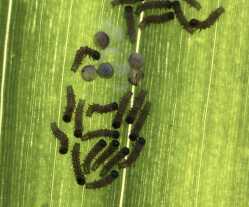
Western bean cutworm has been the primary insect concern this week. Moth flights have been both earlier and heavier than normal, making this an important time for producers to scout corn fields. As fields reach tassel, producers should scout for egg masses in the field rather than relying on pheromone trap counts, as high moth captures do not always translate into economic infestations. Insecticide applications should only be considered when fields reach treatment thresholds, hybrids do not contain the Vip3A Bt trait, and corn is at or very near 95% tassel.
Disease pressure in corn remains relatively low in southwest Nebraska. I personally have not observed bacterial leaf streak or tar spot locally; however, both diseases have been confirmed elsewhere in Nebraska and in neighboring eastern counties. Producers are encouraged to continue scouting fields, and anyone suspecting disease is encouraged to contact Nebraska Extension for assistance with diagnosis and confirmation.
If you use social media, we have a new promotion called Scout Nebraska, where you can win cash prizes for finding our highlighted pest. You can find this by searching across social media using #ScoutNebraska.
This report reflects general crop and field conditions across southwest Nebraska. Individual field conditions may vary depending on location and recent rainfall.
For questions or comments please contact Ruby Collins at the Red Willow County Nebraska Extension office.