 Menu
Menu


Immigration hot topic during Sen. Ricketts’ McCook visit
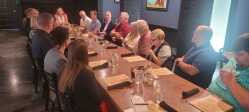
McCOOK, Neb. — U.S. Senator Pete Ricketts spent a great amount of time in McCook on Thursday, July 2, at both The Coppermill and the Keystone Building. The McCook Gazette, city and county government officials and other members of the community were invited to attend a luncheon, where he spoke with his constituents and welcomed questions regarding issues that concerned McCook, the state, the country and the world as a whole.
Attendees were not shy about bringing up major topics as local as the ICE detention facility, the ongoing conflict with Iran, and everything in between.
Ronda Graff, McCook, broached the subject of the ICE detention facility north of town, and how the balance can be made between immigration enforcement and growing communities.
“You're here in McCook. You know, this hits very close to us. I mean, we're dealing with this right here, whatever your feelings are on that. What are you doing, then, to address the process for the immigrants?” she asked. “If you look at the waiting times of what it does take to do it right, it's incomprehensible. I mean, it's getting longer and longer. So, what do you do to address it? Another issue here in Nebraska, if you look at the communities that are growing, they are growing because of immigrants. The majority of the communities in Nebraska, their population base, we need our population to stabilize and grow, and it’s growing because of the immigrant population. How would we help that process then?”
Ricketts admitted to the attendees that the immigration process has lengthy delays, but stated it wasn’t due to an immigration problem. Instead, he said, it is a management problem. He likened the optimal process results to those he encountered while improving other turnaround processes.
“It's a management issue at that point, similar to what we did when I was governor of Nebraska. So, it's not an immigration issue, but when I came in as governor of Nebraska, it was taking us over 40 days to process the SNAP applications. That was because the process wasn't right. We applied Six Sigma. We streamlined the process to set a goal of processing every SNAP application in 10 days. Our air construction permits were taking 190 days. We got those down to 60,” Ricketts said. “So, there are management practices you can put in place that the private sector uses every day that work in government, and that's the kind of thing we need to apply to our immigration process for the people who are doing it the right way, the people who are doing it legally. The whole thing just needs stabilizing.”
One thing Ricketts said he would like to see done is targeting an area where there is a need, such as bringing in more nurses due to a nursing shortage, and streamline the process.
Constituent Jesse Steven, McCook, asked Ricketts what the next steps were now that the U.S. Supreme Court struck down a presidential executive order that sought to deny citizenship to babies born in the U.S. to undocumented immigrants or parents with temporary visas.
“I would say obviously we're going to respect the Supreme Court's decision on birthright citizenship,” Ricketts replied. “I think there are things that are very concerning, like if people are abusing the system to come here on tourist visas and have babies. I think that's a problem. I can see potentially somebody trying to produce legislation. You’re potentially going to have to have 60 votes, so you have to have some Democrats.”
Sen. Dave Murman, District 38, prodded further, asking Ricketts about whether or not birthright citizenship is causing problems within the healthcare or education systems.
“I think the big concern there right now is going to be, what about birthright systems for tourism? I think that, while that's somebody taking advantage of system, it's relatively a small number versus what we saw happening in the Biden administration,” he replied.
Also pertinent to small businesses in McCook and the surrounding communities, Ricketts spoke on legislation aimed at helping small businesses in rural communities survive amidst changes in the competitive environment and the economy. Last year, Ricketts said, the Working Families Tax Cut made the 199A permanent for pass-through tax. The act was signed into law in July 2025 and refers to the Section 199A deduction, which allows owners of pass-through businesses -- like LLCs, S-corporations, and sole proprietorships -- to deduct up to 20% of their qualified business income.
“That's really important, because most of our companies here in Nebraska are small businesses, and many of them are pass-through organizations. So, making sure that we made that tax cut permanent allows those small businesses to be able to continue to reinvest.”
Ricketts added that he also helped to make sure credits businesses receive to be able to provide childcare have increased, which helps businesses remain competitive. One of the provisions allows small businesses to pool together and earn a higher deduction to be able to provide that child care.
“Say you've got four different businesses on Main Street that want to provide childcare,” he explained. “They can come together to offer that service. They can get a total combined $600,000 in tax credits, where they may not individually be able to afford to provide that childcare. By pooling together, they can maybe afford it, and they can reap the benefits of getting the tax credits.”
A bill called the 21st Century ROAD to Housing Act just passed last month, which is federal statute aimed at expanding the national housing supply and addressing affordability. Ricketts said passing the bill cuts back on the regulation and the red tape.
“Twenty to 25% of the cost of a new home is that regulation and red tape. So, what our bill does is trying to get at some of those things to be able to cut down on that red tape and regulation to make it easier to build homes,” he said. “For example, one of my bills that's within the overall package would require USDA and HUD to work together more closely to streamline their processes, so they can get their money out the door faster to build homes faster. Another one is removing the chassis from manufactured homes, so that that takes about $10,000 off the cost, and that will make those homes more affordable.”
Other topics for the afternoon included Trump Accounts, FENCE Act, food resilience legislation, Nationwide Consumer and Fuel Retailer Choice Act, SAVE Act and Title 39 reform.
Later in the afternoon, Ricketts met with more constituents at the Keystone Building, McCook.