 Menu
Menu


Omaha pastor rebuilds after rare neurological condition
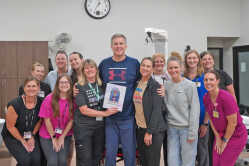
OMAHA, Neb. — For years, Omaha pastor Scott Beckenhauer has encouraged others to trust God through life’s greatest uncertainties. Week after week, he stood before his congregation preaching hope, perseverance and faith.
Then, earlier this year, those same messages became deeply personal.
What began as what Scott believed was a routine illness quickly evolved into a medical mystery. After becoming sick in January, he developed numbness and weakness in his lower legs that gradually spread upward, followed by intense nerve pain. Despite multiple evaluations and treatments, his symptoms continued to worsen.
By April, walking had become increasingly difficult. He was admitted to Nebraska Medicine, where physicians initially treated him for an autoimmune condition. Instead of improving, Scott continued losing muscle function, eventually becoming unable to walk independently.
After further testing, doctors identified the cause of his rapidly progressing symptoms: a dural fistula, an abnormal connection between blood vessels that caused a brain bleed feeding into his spinal cord and resulted in a large lesion in his cervical spine.
“It was a one-in-two-million case,” Scott said. “So, what did recovery look like? Nobody had a clear answer.”
With significant neurological deficits and an uncertain road ahead, Scott came to Madonna Rehabilitation Hospitals, where a specialized interdisciplinary team developed an intensive, individualized rehabilitation program focused on restoring mobility, strength and independence.
When Scott arrived at Madonna, he came with a simple but ambitious goal.
“I want to walk out of here,” he said.
At first, even that goal felt out of reach.
“And being in a position where I was being moved by a harness, that seemed pretty bold,” Scott said.
Early therapy sessions required extensive support as Scott relearned how to walk.
“The first time that we walked, I had to sit in front of him on a stool, help move his right leg forward, block knees, and he just really had a lot of shortness of breath,” Kathy Sievers, PT, NCS, a Madonna physical therapist, said.
High-intensity gait training became the foundation of Scott’s rehabilitation. Rather than focusing solely on balance exercises, the approach emphasizes repetitive walking at challenging intensities to strengthen muscles, retrain the nervous system and improve functional mobility.
As therapy progressed, Scott’s improvements became measurable. His Berg Balance Scale score increased from 19 out of 56—indicating a very high fall risk—to 30 out of 56 after just over a week of high-intensity gait training.
Recovery wasn’t always measured in steps or balance scores. Sometimes, it sounded like an ’80s classic rock karaoke session.
As Scott’s walking sessions became more demanding, Sievers looked for ways to help him stay focused, breathe more naturally and move with greater confidence.
“I started using the music because I noticed he was having trouble breathing when he was doing things and he was concentrating on what wasn’t going well,” Sievers said. “So, I used the music to distract and also get him to breathe so that I could get more walking time out of him.”
Singing became more than a distraction. It helped regulate his breathing, eased anxiety and allowed him to spend more time walking during therapy. For Scott, whose life and ministry have long been rooted in worship, that simple strategy quickly became an unexpected highlight of his rehabilitation.
While Scott’s recovery was centered on rebuilding strength and mobility, rehabilitation involved much more than learning to walk again.
Because of the neurological effects of his condition, he also faced cognitive and motor-planning challenges that made movement more difficult.
“I think the biggest challenge was that physically he could not move,” Dani Willey, OTR/L, DRP, a Madonna occupational therapist, said. “But mentally he couldn’t process through that movement pattern as well. He would almost think about it too much.”
Each therapy session became an opportunity to reconnect his mind and body, rebuilding confidence alongside physical function.
As his mobility improved, therapy expanded beyond the gym. In Madonna’s Independence Square, Scott practiced everyday activities in realistic environments, including navigating the simulated grocery store and playing games with his wife and children. He also stepped out into the community for a lunch date with his wife to celebrate their anniversary, a simple but meaningful moment that reflected how far he had come. The exercises helped rebuild confidence and independence needed to return to the roles that mattered most.
“When he first got here, he wasn’t getting out of bed,” Willey said. “I was having to pretty much help lift him. He didn’t have a lot of movement in his legs. And now we’re standing and he’s barely holding on to anything. He can reach and do a lot of different dynamic tasks that, again, weeks ago, wasn’t even a thought.”
For someone who has spent years helping others navigate hardship, Scott says recovery tested his faith in ways he never expected.
“I’m a pastor,” he said. “People think that just means you’re professionally great at having faith in all circumstances and the reality is, this has brought me face-to-face with so many things about my own personal faith.”
Throughout rehabilitation, encouragement came from every direction—his therapists, physician-led care team, family, friends and church community. One phrase, often shared during difficult days, became especially meaningful.
“Let go, let God,” Willey said. “This is not your burden to carry alone. You don’t have to worry so much. You are going to continue to work hard. Live in the now.”
Accepting that recovery would look different than he had imagined became one of Scott’s greatest challenges. It also became the beginning of a new perspective.
“I had to accept the new reality,” Scott said. “And that’s incredibly hard. But instead of focusing on what has been lost, this is where I begin to rebuild.”
Beckenhauer is the son of Jerry and Cheri Beckenhauer, formerly of McCook.