 Menu
Menu


Nationally-acclaimed artist aims to expose Nebraska’s uniqueness
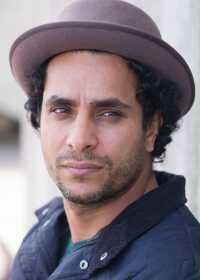
McCOOK, Neb. — Wesaam Al-Badry of Lincoln may be the first person to draft a love letter to Nebraska, and it will be on display as part of the Buffalo Commons Storytelling and Music Festival this month. Displaying a love letter for the world to see might sound odd to the average person, but this exhibit is one of a kind and a sight to behold.
The nationally acclaimed photographer, artist and journalist will display his 19-piece “Labor of Belonging” photography exhibit at the ArtBank, 108 West D Street, as part of the annual festival held June 12 through 14.
“Representation is very important for me. My ‘Labor of Belonging’ was like I wanted to have my own representation of Nebraska. And this place is special to me. Sometimes you have to speak about these places, because other people would look at it in a different lens. Photography has a history of making things beautiful, or also making things look miserable, and I didn’t want this place to be another ‘fly over me state’,” he said. “It was like a love letter to Nebraska, if that makes sense. I love this place. This was my first home, and this is how I want the world to see it.”
For Al-Badry, the project is a way for him to bring Nebraska into the modernity of the world of visual arts and let the world know this state isn’t stuck in the past, he explained.
“I came here as a kid, and this place was very welcoming to me and my family, then I became part of this community. Then I went away [to college], and then I came back because I love Nebraska,” he said. “Because my fondest memory growing up here was the kindness I’ve seen with people, and I think that’s why my images always have a little tenderness to them. Everybody is a unique individual.”
As a child, Al-Badry and his family fled Iraq at the onset of the Gulf War. Before coming to Lincoln at age 11 as a refugee, he and his family spent four years in a Saudi Arabian political prisoner’s camp, where he first experimented with photography. It was the beginning of his journey documenting his experiences, and the essence of human struggle. Telling those stories through art is encouraging to others by allowing them to see their beauty and begin the healing process.
The photographer encourages people to come away from the “Labor of Belonging” exhibit with a desire to learn about their space, learn about their neighbors and their community. Each community is diverse and unique, and he wants people to learn about and from each other.
“I believe in humans, you know. I believe in humanity. That’s my work. It’s always about people. If you notice, I never do landscapes. I’m very interested in people, because I think that’s what draws me. All of us have something beautiful to offer,” Al-Badry said. “When you look at these folks, I want you to know those are your neighbors, those are your fellow citizens. I think there’s goodness in all of us.”
Over the years, Al-Badry said his relationship with photography hasn’t changed much, if at all. The art form, for him, has become two distinct and parallel universes, but following the same purpose.
“There’s the social documentary aspect of it. That’s what I’m mostly known for, the work that I do, and that documents culture and life as we are in society. So, that’s always like, how can I use that as a language?” Al-Badry said. “As well as photography as an art form, which I actually use a lot for my own political views, and how I want to, as an artist, freely speak about my politics and completely separate them from my social documentary work. Because that is what I'm recording, what I see in front of me. So, I have a very complicated relationship, which is beautiful, not in the negative sense.”
To Al-Badry, those two worlds sometimes intertwine. For example, during his “Labor of Belonging” project, which began in 2024, he uses his journalism and documentary backgrounds to actively participate in and showcase the complex subcultures of communities in Nebraska.
The project is ongoing, and looks to challenge stereotypes of the Midwest. Al-Badry has ventured into unlikely settings — living rooms, strip clubs, women’s prisons, prom halls, streets and job sites — to reveal the unique within the ordinary.
But on the other side of the coin, he said, he would like the end product in museums, galleries and books for the aesthetic part of the process.
Al-Badry’s work has been exhibited internationally at Corcoran Gallery in Washington, D.C., the Fine Arts Museums of San Francisco, Cooper Hewitt Museum in New York, Cantor Arts Center at Stanford University, Joslyn Museum in Omaha, Tacoma Art Museum in Washington State, Museum of Nebraska Art in Kearney, Bernstein Gallery at Princeton University, Museum Angewandte Kunst in Frankfurt, Germany; LagosPhoto in Lagos, Nigeria; and many others. His work has also been represented by Jenkins Johnson Gallery of San Francisco and New York City.
The exhibit will be open between 10 a.m. and 5 p.m. on Friday, June, 12, and then at 9 a.m. he will put on his “Labor of Love” presentation. The exhibit will reopen from 10 a.m. to 5 p.m. on Saturday, June 13, at the ArtBank, with the “Dignity, Beauty and Agency” presentation at 2 p.m.
“The presentation will be about people and kindness and compassion, and also the artwork in these images, and how we see one another. I think that's an important thing for me, how do we see one another, and how can we be good to one another, or acknowledge and elevate the other person,” he said. “We're all literally on the same spaceship. For me, it's like, we’ve got to have a dialogue, we’ve got to talk, we’ve got to learn about one another. I think that's what I'm most excited about.”
In addition to photography, Al-Badry is a long-form investigative journalist and interdisciplinary artist focused on environmental justice, immigration, labor and marginalized communities.
He has worked for global media outlets CNN and Al-Jazeera America, and his photography has been featured in the New York Times, Rolling Stone Magazine, The Atlantic, NPR, Fortune, The Nation and Mother Jones.
His photographs and essays have appeared in The New York Times, Rolling Stone, The Atlantic, NPR, Fortune, Mother Jones, Forbes, The Nation, Reveal, Hyperallergic, Vogue Germany, Vogue Arabia, Süddeutsche Zeitung, Art Unlimited Turkey, Zoetrope and Whitehot Magazine. He has collaborated with CNN, Al Jazeera America and Pop-Up Magazine.
The artist earned his Bachelor of Fine Arts in Photography from San Francisco Art Institute, and his Master of New Media Journalism from the University of California.