 Menu
Menu


County tests voting machines ahead of primary
McCOOK, Neb. - Counties across Nebraska are preparing for the May 12 primary election, with required testing underway to verify ballot-counting equipment.
In an April 17 press release, Secretary of State Bob Evnen said county election offices are conducting logic and accuracy testing as part of their preparations.
“Each of our 93 counties will perform tests of their equipment to check that the machines are working properly prior to election day,” Evnen said. “These tests are completed before every election and are one of the processes we have in place to ensure Nebraska’s elections run smoothly and accurately.”
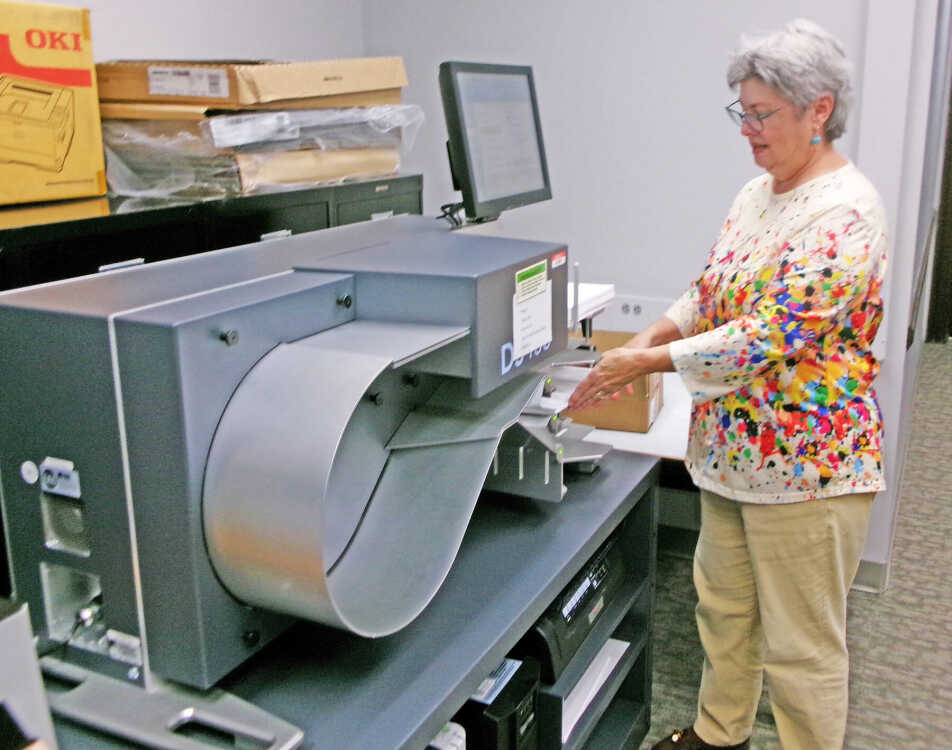
Logic and accuracy testing is required before every statewide election under Nebraska law. Three sets of test ballots are used to verify tabulators. One set is provided by the vendor that programmed the equipment, one is completed by an election official, and one by a voter registered with a different political party. Results must match expected totals exactly for the test to pass.
The Gazette observed testing Tuesday afternoon at the Red Willow County Clerk’s Office.
A law passed by the Nebraska Unicameral last year allows one representative from each recognized political party to observe the process. Bill Hoyt attended as an observer for the Red Willow County Republicans.
County Clerk Penny Cooper outlined the procedure before testing began.
“The state sent us test stacks, and we run them through to make sure the totals match,” Cooper said. “If they don’t, we have a problem.”
Deputy Clerk Jasmine Dimas conducted the test using the ES&S DS450, manufactured by Election Systems & Software. The unit, described by the manufacturer as a high-throughput scanner and tabulator, costs about $55,000. The county has one.
Dimas said the scanner processes each ballot and either accepts it for tabulation or flags it for review. Ballots with write-in selections are captured for later interpretation, while those with overvotes, unclear markings, or read errors may be set aside for adjudication.
She also described how the machine separates ballots during processing.
“If they go in the top tray, something is wrong and the machine didn’t read it,” Dimas said. “The middle tray is for write-ins. If the ballot is fine, it goes to the bottom.”
Asked about security, Cooper said the tabulator is not connected to the internet.
“Nobody’s talking to it, and it’s not talking to anybody,” she said. “After the ballots are counted, we use a removable storage device to transfer the results to a system that uploads them to the Secretary of State’s website.”
Cooper said counties will participate in a coordinated statewide test next week.
“Everybody does it at the same time to make sure we don’t overload the Secretary of State’s website,” she said. “On election night, we run the zero report, then process absentee ballots at seven and Election Day ballots after the polls close.”