 Menu
Menu


Turnout reflects interest in races
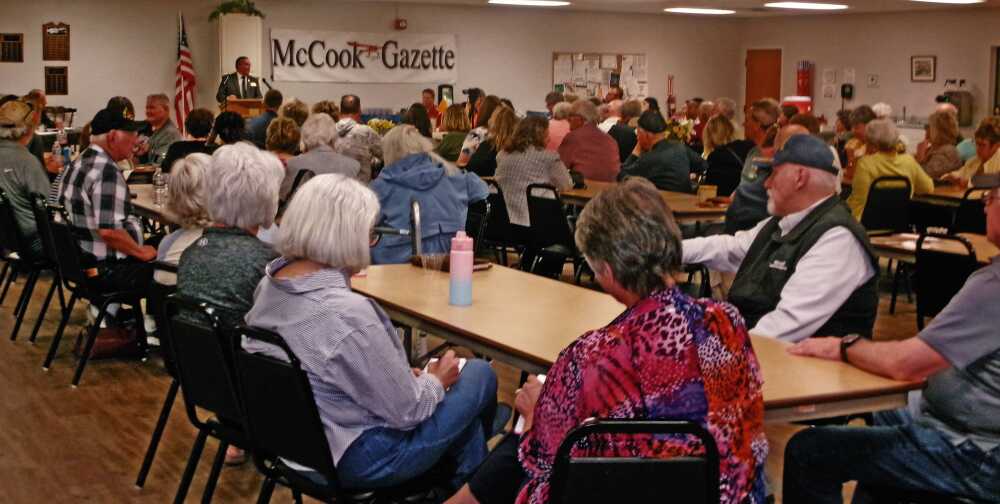
Family ties and community connections were as prominent as the expected themes of property taxes, economic development and public safety at Tuesday night’s Candidate Forum at the McCook Senior Center. Twenty-six candidates across nine races, including all five contenders for the 38th District Legislature, took part.
In-person attendance was estimated at 75 to 100, with additional viewers tuning in online, as the forum was also broadcast live on KICX and KBRL. The strong turnout underscored both the depth of the ballot and the shared challenges facing Southwest Nebraska.
The event featured contenders for federal, legislative and local offices, who responded to questions posed by a panel representing community stakeholders. Community Hospital President Troy Bruntz represented the McCook Economic Development Corporation, Jeremy LaBrie of Memorial Methodist Church represented the Red Willow County Ministerial Association, Mayor Linda Taylor represented the McCook Community Foundation, and Jessica Armstrong represented the McCook Parent Teacher Organization. Ronda Graff, also of the McCook Community Foundation Fund, was the official timer for the event, and High Plains Radio General Manager Bryan Loker acted as moderator.
Loker guided candidates through a consistent format that included opening remarks, two questions and a closing statement.
Third District
Running for Nebraska’s 3rd Congressional District in the U.S. House of Representatives, Macey Budke addressed issues of rural healthcare access, economic opportunity and housing affordability. Budke emphasized the challenges facing rural hospitals and advocated for structural changes to healthcare funding, noting the need to shift toward models that prioritize access in sparsely populated areas. Budke also criticised the district’s current representation, saying, “Our current representative has been in office for 20 years and is so far removed from the reality of everyday life here in our district that he has lost the most important aspect of public service, staying connected to his constituents.”
County Clerk
In the race for Red Willow County Clerk, Republican incumbent Penelope Cooper and challenger Leanne Miller highlighted experience, communication and administrative efficiency. Both candidates stressed the importance of accuracy and responsiveness in an office responsible for elections, records and budgeting, with Miller emphasizing relationship-building and Cooper pointing to her long tenure and institutional knowledge. Cooper said, “This isn’t a job that you can learn in a couple of months. Honestly, it takes years.”
Miller, in her closing statement, emphasized her preparation for the position, saying, “I’m not stepping into this lightly. I put a lot of thought and research into what this role requires, and I’m committed to doing it well.”
Law Enforcement Races
Law enforcement and public safety were central themes in the sheriff races. In Frontier County, Republican Michael Jordan discussed efforts to modernize emergency systems and strengthen school safety partnerships saying, “Just the presence around the school is a big part of our school safety plans.”
In Red Willow County, Republican candidates Dalton Downing and Milton Varney focused on interagency coordination, staffing challenges and community engagement, with both emphasizing visibility and accessibility as priorities. Downing concluded his discussion by saying, “Voting for me is voting for proactive law enforcement that is accountable and more transparent.”
Varney concluded his discussion by saying, “I just want everybody to know that [if] you’re voting for Milton Varney, you’re actually voting for the people of Red Willow County, so we can have the trust in what we need.”
County Board
Republican candidates for Red Willow County Board of Commissioners included incumbent Ted Gans and challenger Joseph Robinson in District 1 and incumbent Charles Fritsche and challenger Michael Pochop in District 3. All centered their discussions on fiscal responsibility, economic development and transparency and spoke broadly about balancing budgets while maintaining essential services.
Gans emphasized cost-saving measures already implemented at the county level, citing a rebid of property and casualty insurance, “which saved the county in one year $150,000.”
Robinson acknowledged the importance of budgets, saying, “Budgets are a reality. You have to meet budgets now. Can you cut costs in areas? Absolutely.”
Fritsche said he would “go with the top priority of what needs to be done and work down. Everybody knows, you can’t spend money you don’t have.”
Pochop spoke in broader terms, saying, “We can do a good job of maintaining the resources of this community by examining and reducing loss to people, systems, product, materials and equipment.”
School Board
Only four candidates filed for three seats on the McCook School Board, so all will bypass the primary and advance to the general election. Three candidates, however, accepted the Gazette’s invitation to participate in the forum.
Tasha Blomstedt focused heavily on academic competitiveness, particularly the district’s grading scale. She raised concerns that McCook’s current system—where a 93 percent is recorded as a 3.0 “B”—may disadvantage students in scholarship and college admissions comparisons. Blomstedt said, “I think that that’s very hard when you are applying for scholarships.”
Nathan Hudson centered his remarks on facilities, particularly the condition of the junior high building. He said it is “undeniable” that action is needed, while acknowledging that the proposed multi-million-dollar bond has raised concerns within the community. Hudson also addressed the ongoing challenge of teacher recruitment and retention, noting the statewide shortage and the use of incentives such as signing bonuses. Noting the difficulty of the job, Hudson said, “Let me tell you, if you’ve been a first-year teacher in the classroom, teaching fifth-grade band, man, you earn that paycheck.”
Incumbent Mike Langan highlighted what he described as the district’s strong academic performance, noting that Nebraska ranks among the top states in education and that McCook compares favorably with state averages and peer districts. He pointed to outcomes within his own family as an example of the system’s foundation. Langan said, “McCook outperforms the state, and we outperform our peers in nearly every category, from first grade all the way through senior high. So academics are great.”
More coverage to come...
The largest field of the evening came in the McCook City Council race, where candidates Joel Arterburn, Dennis Berry, Chelsey Eng, Dean McCoy, Kaleb Taylor, Nick Umsheid, Gene Weedin and Rose Weskamp addressed issues including infrastructure, housing and economic growth.
The city council candidates were then followed by all five of the contenders for Nebraska’s 38th District, including Tim Anderson, Jon Capps, Janell Anderson Ehrke, Melanie Knight and Wes Wilmot.
Look for coverage of the City Council and State Senate races in upcoming issues of the McCook Gazette.