 Menu
Menu


McCook revisits Norris legacy
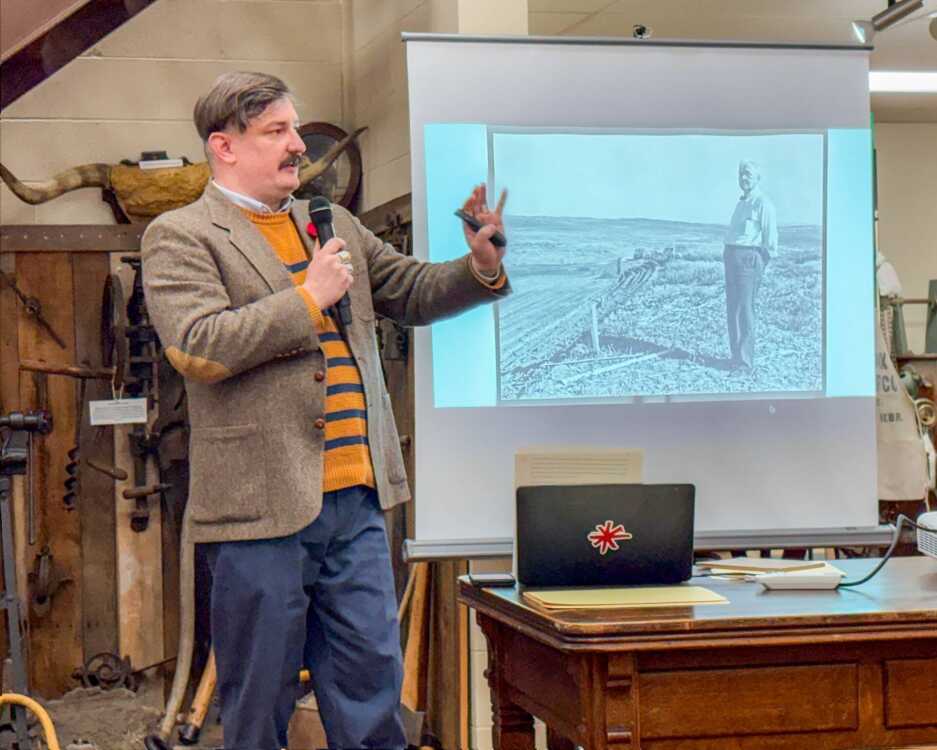
McCOOK, Neb. - “Norris was a fighter who hated bullies. He was a pugilist,” said Dr. Nathan Tye, an associate professor at the University of Nebraska Kearney Department of History, who delivered an in-depth analysis of famed Nebraska Senator George Norris.
Tye’s presentation, titled George Norris: At War and Peace, centered around themes Norris discussed in his memoir Fighting Liberal and a short address called “Peace Without Hate.” Regarding “Peace Without Hate,” Tye said, “He had a vision for what he wanted the world to look like, the world that he was no longer leading, a world that he was nevertheless very deeply invested in.”
The question Tye posed for his McCook audience was not one of political stance, but drawing from something deeper. He wanted to know why Norris was such a strong advocate for peace in the first place. After all, George Norris was simply an attorney from McCook. “Why was a McCook attorney often the lone political voice advocating for peace in the Senate?” Tye asked.
Tye stated that Norris was ever an idealist and tirelessly advocated for the common person, and noted that Norris’s vision was “birthed from tragedy.” “His life was defined by tragedy very early on; his life was defined by war and peace,” Tye said, “He was born amid the Civil War, and he died in the middle of the Second World War.” Norris’s fight against the First World War and his rigorous advocacy for democracy and for peace were constant throughout his political career.
“Norris was a fighter who hated bullies. He was a pugilist,” said Tye. Later, he pointed out that Norris “had disdain for those who trampled on common people and those who misused government resources.”
A Chapter from John F. Kennedy’s “Profiles in Courage,” (a book later revealed to be ghost-written by Nebraskan political adviser, lawyer and writer Ted Sorensen) included a favorable description of George Norris reading: “Nothing could sway [George Norris] from what he thought was right, from his determination to help all the people, from his hope to save them from the twin tragedies of poverty and war.”
In the early 1900’s, Norris led a revolt against powerful House Speaker Joe Cannon and introduced a resolution that successfully stripped the Speaker of his control over the Rules Committee, an overreach of power that let Cannon block legislation and control the House agenda. Norris’s resolution created a decentralized process that moved power to block and delay legislation from one person to a larger committee of 15. It’s now known as the Committee on Rules and seats 13 members, nine Republicans and four Democrats.
Norris also advocated for the establishment of the Rural Electrification Administration, which would eventually be realized and provide federal loans for the installation of electrical infrastructure in rural areas of the United States. “He wanted the common person to have the resources and the material reality of anybody else,” said Tye.
Tye illustrated that Norris’s upbringing amidst the American Civil War helped define a philosophy he would eventually apply to politics. “The Civil War laid the foundation for what we saw from George during the First and Second World Wars,” Tye said, “[Norris’s family] had very, very little. They made the best they could with what they had, and they saw the possibility and the potential for a government that would be dedicated to improving their lives, not the lives of the rich and powerful.”
Controversially, George Norris took a position against the U.S. arming of European merchant ships in 1917, which we now know as the start of World War I. After his decision, Norris knew it was important to speak to voters from across the state and make known their concerns. Tye said Norris felt obligated to “explain to them why I want out of this war, why I want peace.” Norris held rallies across the state, including Holdredge and McCook, the purpose of which was to communicate with his constituents, Tye said. Norris heard their overwhelming support. When Norris eventually relayed Nebraska’s position, “President Wilson was furious,” said Tye.
Public sentiment changed quickly, however, and in the few short weeks after Norris’s talks with Nebraskan voters, newspapers in Nebraska were shown to be in support of entering a European conflict. Even still, Norris stood strong on his position. Tye said, “He told the president that he’s still going to vote against the war, and he criticized the war profiteers and the newspaper editors who were drumming up support for the conflict.”
Tye showed a quote from Norris during a filibuster, “This has been brought to the present moment when Congress, urged by the President and backed by artificial sentiment, is about to declare war and engulf our country in the greatest holocaust the world has ever known, and specifically, unborn millions will bend their backs and toil in order to pay for the terrible step we’re about to take. We’re about to go do the bidding of wealth’s terrible mandate… This is a war for profit. This is not a war for Americans. This is not a war for common people.”
“He disdained war. He crossed party lines. He was very much a maverick,” said Tye. Norris led a successful filibuster, but one day later, President Wilson called the 65th Congress to a special session and signed an executive order, surpassing Norris’s Congressional efforts.
Tye examined Norris’s decision to oppose US involvement in WWI, stating that Norris didn’t think going to war was the “actual sentiment” of the people of Nebraska, and so he opposed the conflict altogether. A quote from Norris read, “If you are just to vote on the whims of what you think is popular, then what’s the point of an elected official, otherwise a member of Congress giving way to express public sentiment only becomes an automatic machine. If it is the line of duty of a member, then Congress requires no patriotism, no education and no courage. All a member has to do if he does follow that which he believes to be the will of his constituency at all times, is to attempt to take such actions as will bring him the most votes in the next election.”
Nonetheless, after Wilson entered the war by executive action, Norris pledged his full support to the war effort. “George Norris was an ardent champion of the United States Army during that period,” said Tye, “and he continued and was reelected time and time again.”
During WWII, Norris’s isolationist efforts subsided. “He understood that the world was different,” said Tye, “This was a war of extermination, and so he did temper his views.” Norris ultimately gave his continuous support to President Roosevelt during WWII. “This challenged a lot of the people around him,” Tye said, adding, “His position on war hadn’t changed, just what the war was about.”
In 1942, George Norris debated whether to run for another term in Congress, citing doubts that he was the right fit for the time. Eventually, though, he ran again, but it was too late. Tye said, “And so, George Norris was, for the first time since the turn of the century, out of Congress.”
After his loss, Eleanor Roosevelt sent him a private letter which read, “You have established a reputation for integrity and courage, which gives youth a belief in its own idealism. You are the model for the youth of today.”
Tye’s presentation concluded by recounting Norris’s 1943 address titled “Peace Without Hate.” In it, Norris was quoted as saying, “A permanent peace will not come out of any peace that is framed in hate and dedicated to posterity with the spirit of vengeance. What is necessary in order to achieve perpetual peace? It is not difficult, it seems to me, with all the experience that is behind us, to tell us what that is.”
Norris delivered that final address to the University of Nebraska, Lincoln, in 1943, and died only a year later, just before the end of WWII.
The message Tye left was that Norris “Didn’t want us to know that we could turn on our lights at our farmhouses. He didn’t want us to know about the 20th Amendment. He didn’t want us to know about his filibuster. He wanted us to know that we can have a better world if we want it.”