 Menu
Menu


New apartment complex taking shape on West First
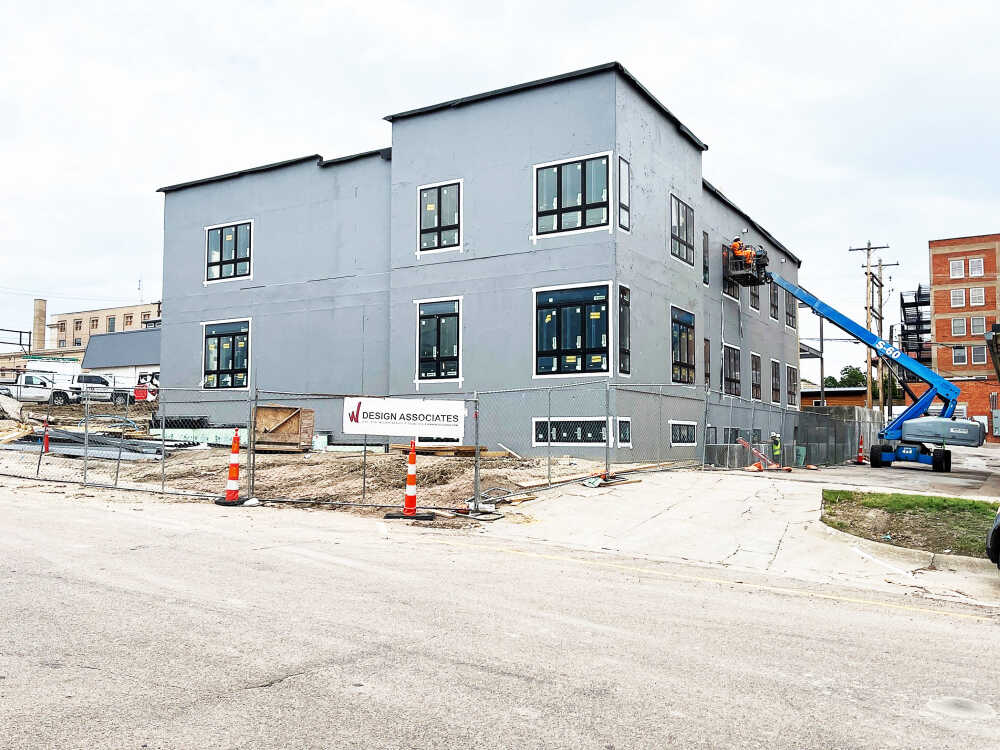
McCOOK, Neb. — As rural hospitals face growing challenges in recruiting and retaining medical staff, shifting demographics and limited housing options are often to blame. In McCook, organizers of a new apartment complex hope their project will help address those issues.
Citizens of McCook have been closely following the progress of a new apartment building being built on West First Street. Slated for completion this fall, the 12-unit facility is being built by Community Hospital of McCook. Named “ROOTS” (Rural Opportunities Offering Tomorrow’s Success), it’s expected to welcome its first student residents by January 2026. Already, five units have been booked for 2026.
The apartment complex will provide temporary housing for medical students and other professionals completing rotations at the hospital.
Affordable housing is one of several key factors residents consider when choosing a rotation, said Lori Beebe, Vice President of Support Services at Community Hospital. Often, housing during rotation is provided in different parts of town, or students may choose a rotation in a location where they have family members they can stay with. Studies have shown that if a student can have a rotation in a rural environment, they’re more likely to locate in a rural environment. “We’d love for that to be McCook, but this also helps promote just rural in general, whether it’s healthcare or just a rural community,” Beebe said.
The housing effort is a way to counteract broader trends in rural healthcare. “We’re seeing people retire and fewer students entering healthcare,” Beebe explained. “Some colleges have waiting lists, while others aren’t filling seats.” In McCook, the population is aging, which increases the demand for services.
According to Beebe, providing rotations in rural areas and making those experiences positive can influence future career decisions and show the advantages of small-town living. “We’re realistic and we know that they might not come back to McCook, but we can still give them a good experience in a rural environment so they can see that rural spaces are really amazing,” she said. Residents will not only get to know the hospital, but McCook itself. “Being located downtown gives them access to Chamber events, community festivals like Third Thursdays and the ability to walk around and experience life in a rural setting.”
Attracting more residents can help the area as a whole. Beebe explained, “Even if they went to Benkleman or to Imperial, or any of these other communities, they get to see it’s not so bad; that they could live in Imperial. That’s still a win for us, because we’re still getting these really amazing providers that can help us.”
Community Hospital has relationships with various colleges for programs, such as Mid-Plains Community College, the University of Nebraska Medical Center, the University of Nebraska-Kearney, the College of St. Mary’s in Omaha, Fort Hays University, and even colleges in Colorado and Wyoming. The new Health Sciences Building at UNK will expand the number of students they can have, so this project dovetails nicely with those efforts.
Beebe said the hospital hopes to collaborate with other local organizations that are also trying to recruit short-term professionals, such as student teachers or engineers.
“There are other groups who are also facing challenges finding temporary housing,” Beebe said. “We’d like to be a partner in solving that.”
Currently, the hospital rents units at the Oakview Apartments. With rental inventory tight, the new apartments will help ease the housing bottleneck and free up rentals for local residents.
Each apartment will have a full kitchen, with two two-bedroom units and ten one-bedrooms. There is also a shared common space for social and study areas. Stay lengths will vary, from a few weeks to three months, depending on the student’s rotation and specialty. The hospital students and residents will be provided with the housing as a way to support them while they are here. A basic monthly fee will be established for students and community partners alike.
The apartment building, at $5 million, is funded through a combination of hospital resources and support from outside foundations. Both local and out-of-town contractors are being used for construction, according to Beebe. Parking will be available for residents, with spaces located next to the building and off-street parking options, as well as the city parking lot situated north of the building.
Ultimately, Beebe said the hospital views the housing project as part of its broader mission to lead the region toward a healthier future, not just through clinical care, but through community building.
“We’re only as strong as our community,” she said. “If ROOTS can be one more reason students and professionals choose to live and work here, or even just gain appreciation for rural life, that’s a big win.”