 Menu
Menu


Hospital outlines expansion, new services
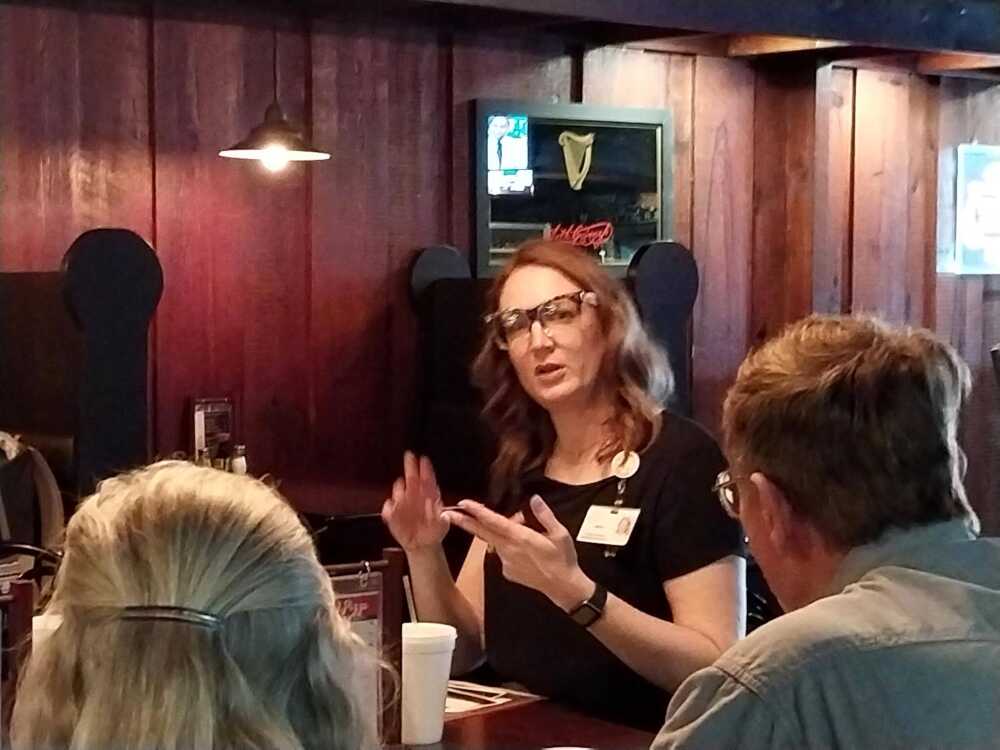
McCOOK, Neb. - The themes of renovation and expansion will likely dominate any headlines about Community Hospital in the weeks, months and years ahead. They should. The institution is as much an outward-facing point of pride in the community as it is an economic engine, but when Molly Smith addressed the March Coffee Talk gathering, her focus extended well beyond bricks and mortar. Smith outlined an institution guided as much by its commitment to care and community responsibility as by its broader role in the region’s economic and civic life.
Smith, the hospital’s director of communications, described a rural healthcare system in transition—one expanding its reach while holding fast to a core mission of keeping care close to home. Over the course of the discussion, she traced the hospital’s evolving role across Southwest Nebraska, touching on workforce challenges, new technology, regional partnerships, and a slate of major projects that will reshape the campus in the years ahead.
Smith began the discussion by introducing herself to the small gathering at Citta’ Deli in lower downtown McCook. Originally from New Mexico, Smith came to McCook after a career that included teaching and public relations work. She joined the McCook Area Chamber of Commerce before moving into her current role at the hospital, where she oversees both internal and external communications, including media relations, social media and community outreach efforts.
Assessment
That outreach function, she explained, is closely tied to one of the hospital’s most important planning tools: a community health needs assessment conducted every three years. Through surveys and engagement with residents, businesses and organizations, the hospital identifies community needs and uses that information to guide both programming and long-term strategy.
Smith said, “Basically, it says, hey, here are the gaps that you have. Here are the gaps (between) meeting the needs of our patients and our communities, and what you guys provide.”
Those assessments have increasingly pointed to a familiar challenge across rural America: limited access to care, particularly in specialized fields. Smith emphasized that the hospital does not attempt to provide every service locally, acknowledging that some patients will always need to travel. However, the goal has been to reduce that need wherever possible.
That approach has driven a significant expansion in oncology services, which Smith identified as one of the region’s most pressing needs. Prior to recent changes, patients often traveled two or more hours for regular treatments such as chemotherapy. Recruiting an oncologist to practice locally marked a turning point, allowing many of those patients to reduce both the financial and physical burden of travel. Smith said, “Our mission really is to make health care close, close to home.”
Foundation
The hospital has continued to build around that service line, and Smith described cancer care as a central focus moving forward. Planned improvements include facility upgrades and new equipment, such as a linear accelerator for radiation oncology. The project, expected to cost several million dollars, will be supported in part by the Community Hospital Foundation, which has become an increasingly important partner in funding major capital needs beyond departmental budgets.
More broadly, technology has become a priority, particularly as the hospital seeks to recruit and retain younger physicians trained on newer systems. Smith noted that surgical training now routinely includes robotic systems, making the purchase of a surgical robot not only a clinical upgrade but also a recruitment necessity. The equipment, estimated at roughly $3 million, is expected to improve outcomes through less invasive procedures and faster recovery times.
Smith credited the foundation for much of the hospital’s ability to move forward with those investments. “The Foundation does a really great job of granting money to departments for those needs.” She explained that while departments operate within fixed budgets, the foundation helps make possible equipment purchases that would otherwise remain out of reach.
Smith said, “A surgical robot was probably not on surgery’s budget this year, but it’s something we need. And so the foundation, I think, will be able to help contribute to that.”
At the same time, the hospital faces ongoing workforce challenges that extend far beyond McCook. Like many rural providers, Community Hospital competes for a limited pool of nurses, physicians and clinical staff. Smith said the issue is not primarily compensation, as pay tends to be competitive, but geography. Many healthcare professionals prefer to remain in larger population centers after completing their training, making recruitment to rural areas an uphill effort.
Roots
To address that challenge, the hospital has taken an unconventional step by investing in workforce development infrastructure. The “Roots” apartment complex, built specifically to house students and trainees, is intended to expose future healthcare workers to rural practice.
Smith explained, “We were renting half of the town…every rental that was available, we had it. And that was taking away from our own community… so about three years they said, Hey, let’s do this weird thing that nobody in the whole of America has done, and let’s build an apartment complex for the hospital. And so that’s what happened.”
By providing free housing for students and partnering with educational institutions, the hospital hopes to create a pipeline of professionals who may choose to return to similar communities later in their careers.
The concept extends beyond recruitment to broader community support. When units are not fully occupied, the hospital has made space available to local partners, including schools and industry, which face similar housing shortages for temporary workers and trainees. Smith described the effort as both practical and strategic, aimed at strengthening the region’s overall workforce capacity.
Collaboration
Regionally, the hospital has taken a collaborative rather than competitive approach. Smith emphasized that Community Hospital sees itself as a partner to smaller facilities rather than a rival. Staff work to support those institutions where possible and marketing efforts are deliberately focused away from areas already served by neighboring hospitals.
Of those efforts, Smith said, “You know, we try to be good team players to them in marketing. It’s really important for us… We’re kind of the big fish, and we don’t want to overstep, so most of our marketing actually goes west.”
Smith clarified, “I rarely market East because I just don’t want to take patients who already go to Cambridge.”
That philosophy has also shaped the hospital’s growing outreach footprint. While it continues to host visiting specialists from outside the area, the hospital has increasingly begun sending its own providers into neighboring communities. Oncology services now extend into parts of Kansas and Colorado, reducing travel demands for patients in those regions while strengthening ties between facilities.
Closer to home, Community Hospital operates a satellite clinic in Trenton. It also maintains a network of more than 30 visiting specialists who supplement local services across the region. Many providers live within the region, though some commute from neighboring states or fly in on a regular schedule. In that context, Smith noted that access to air transportation plays a meaningful role for both provider travel and patient transfers requiring rapid transport.
While expanding services, the hospital has also placed emphasis on improving the patient experience. Smith acknowledged that patients often arrive at the hospital during difficult moments and stressed the importance of compassion and communication. Efforts to integrate services and reduce fragmentation have become part of that broader goal.
Renovation and expansion
Those efforts are reflected in a series of major construction projects now underway or in the development stage. The most prominent is a new cancer center, which will consolidate radiation oncology, medical oncology and infusion services into a single location on the east side of the campus. The project is driven by growing demand and space limitations in existing oncology areas, where patients often undergo lengthy treatments in confined settings. The new facility is designed to expand capacity, improve patient privacy and comfort, and streamline care delivery.
Additional projects include a new primary care clinic on the west side of the campus and a significant expansion of the hospital’s central utility plant. The utility project will modernize critical infrastructure, including power, heating, cooling and medical gas systems, improving reliability, efficiency and long-term capacity for the entire campus.
The new clinic building will significantly expand primary care capacity with additional exam rooms, procedure space, and integrated lab and imaging services. The facility is designed to support incoming physicians, reduce scheduling delays and improve access for rural patients, while also accommodating student training and workforce development needs. Existing clinic space is expected to be repurposed for specialty services as operations shift into the new building.
The multi-phase construction effort is expected to unfold over several years, with a tentative completion timeline extending into 2028. Hospital officials anticipate beginning work on key components in the near term, with infrastructure improvements serving as a prerequisite for larger expansions.
Looking ahead, the project is also expected to support future expansion of the emergency department. Once oncology services are relocated, the existing infusion space will be repurposed to help address current space constraints and patient volume pressures.
Community interaction
Beyond facilities and technology, Smith highlighted a range of community-focused programs designed to improve health outcomes outside the hospital setting. Those include educational initiatives such as the “Healthy Connections” program for older adults, as well as support groups, wellness services, and preventive care outreach. The goal, she said, is to engage residents earlier and reduce the need for more intensive care later.
Taken together, Smith’s remarks outlined an institution balancing growth with restraint and expansion with partnership, continuing to push toward a model in which more care can be delivered locally, efficiently and with greater coordination.
In a region where distance has long defined access to healthcare, that shift may prove as significant as any single project. As Smith put it, “Our mission really is to make health care close, close to home.”