 Menu
Menu


McCook's Social Scene, 1882
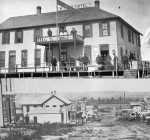
Though the new little city of McCook did not have its beginnings until the summer of 1882, by fall there was already quite an active social schedule, much of which revolved around dancing. The first dances were held in the social hall and outdoor bower of the new Congregational Church (on the site where the present Congregational Church now sits, at the corner of East Second and E), but it was not long before dances were routinely held in one of the new hotels in town, the Commercial Hotel at what is now Norris and C St., or at the original McCook Hotel, which was located at what is now East 1st St. and B -- or sometimes at one of the "vacant" buildings in downtown McCook, often buildings which were completed but had not yet been occupied by a new business owner.
In 1882, there were no "orchestras" in town to play for the dances, but from the beginning there were a few of the new settlers who had brought their instruments with them and were willing and able to share their talents at the dances. There was usually a piano and violin, and often a "Jew's Harp," and drums and a washboard to keep time. One piano, which played a prominent role in providing music for dances at the Monte Carlo (an upstairs dance club in McCook), was recently given to the High Plains Museum by Tom Kiplinger.
McCook may have been a new town, but, from the beginning it had aspirations of becoming a real city, with a great social scene, with parties and dances, even though ladies in McCook at the time were in extremely short supply. These country dances were announced as "Balls," or "Grand Balls," with themes for the events.
One of these Grand Balls was described in the McCook Tribune. The highlight of this particular affair was the awarding of a "fine solid 18 carat ring" to "The Best Lady Dancer." In the days leading up to the affair there was keen interest in this award, but it was reported, "The only lady present at the event who admits to its success of awarding the ring is the one to whom the ring was awarded."
One dance was announced as a "Grand Calico Dress and Necktie Ball." At this dance ladies were supposed to attire themselves in calico, or at least inexpensively, and the men were to wear neckties that matched, or harmonized with their companion's dress.
At one "Grand Ball" a greased pig was released in the ballroom. Those who desired to do so were invited to catch the pig if they could, the reward to the person who caught the pig was the pig itself. It was planned that catching a greased pig would provoke much hilarity for those in attendance, but there was a problem. The pig selected for the occasion was either so docile, or so confused by his surroundings that he was easily caught, without difficulty and an absence of hilarity, and that portion of the Grand Ball was declared a "fiasco."
"Besides the actual dancing and the conversations between neighbors that went on at these "Grand Balls," there was another quite common form of entertainment (?) -- that of the presence of cowboys, from ranches sometimes many miles away from McCook. "It is by no means an uncommon thing for fistic encounters to occur at dances -- not in the vicinity, but right out on the ballroom floor. The cowboys, who are avid for excitement when they come to town, are frequently in a state more or less intoxicated by the time they reach the dance.
"Resentment on the part of the town boys toward the demeanor shown by some of the cowboys is sometimes a cause of trouble. But town boys frequently belabor one another when feelings run high at entertainments of this sort, and yes, the cowboys fight among themselves, or with the town boys -- or anyone else. They don't seem to really care with whom they fight once trouble breaks out. While bare fists are usually the only weapons used, guns, which a large fraction of the male population of this place believe they must carry, are not infrequently brandished -- though seldom brought into action. Eventually the belligerent participants tire. Cooler heads prevail, and the dance resumes.
At one of the Galas, the following story was the buzz of the party -- "a strange story, illustrating the fickleness of the women who arrive out west. A young lady from some eastern city recently made her appearance in one of the towns that have sprung up in the last few weeks this side of the Colorado line. She soon found employment in the one hotel of the town. Being attractive in appearance, she soon had a following of swains from the neighboring ranches, several of whom pressed their claims for preference. Without undue delay she chose as her favorite, a cowboy of the Lazy L outfit, to whom she pledged her troth, and the wedding was set for an early date.
"This lady was not blessed with a store of this world's goods, and as her lover wanted her to be married in fitting attire, he took her to Denver, where he purchased and presented to her a trousseau that set him back more than two hundred dollars. After their return from Denver she went back to her employment in the hotel, and he went back to work at the Lazy L until their wedding day should arrive.
"The soon-to-be groom found it necessary to be gone for a few days. During his absence his lady made the acquaintance of a cowboy who worked at the Quarter Circle K ranch. It was a case of love at first sight. Not knowing that she was engaged to the boy at the Lazy L, the cowboy from the Quarter Circle K ranch proposed to the young lady and was promised her hand in marriage, and their nuptials were celebrated without delay.
On his return, the cowboy from the Lazy L quickly learned what had happened.. He said that his only regret was that he had spent his money on a woman whose affections were so fleeting.
A dance was held in honor of the lady and her new husband, from the Quarter Circle K. This dance was attended by her old love from the Lazy L, who had supposed that he would have been the groom so honored on this occasion. His only remark was that he hated to see the one he believed would be his bride (but was now the bride of another), swinging around the ballroom in the calico gown that he had purchased."
We are not told if the two cowboys, one from the Lazy L, and the other from the Quarter Circle K exchanged words that night, or if the boy from the Lazy L found love and happiness at a later dance.
Eligible young women in Southwest Nebraska were something of a rarity, and single ladies continued to be aggressively sought after for many years after 1882.
Source: From McCook Tribune columns, collected by H. P. Waite.