 Menu
Menu


Food sales to benefit Rotary's anti-polio effort
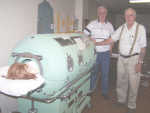
It was the disease that struck without warning, killing and paralyzing thousands of children in the United States until 1955. And the memories are still vivid for those who lived through those polio epidemics in the 1940s and '50s.
"It was scary, our parents wouldn't let us go anywhere," remembered Dr. Donald Morgan, who was raised in McCook and later practiced medicine here for 35 years until he retired in 1988. "They were so afraid we'd catch it."
Polio has now been eradicated from the United States and Europe, but the highly contagious, viral disease that kills and disfigures primarily children is still active in Nigeria, India, Pakistan and Afghanistan.
To that end, proceeds from Dr. Batty's Breakfast Burritos, sold in front of the Fox Theater on Norris Avenue Saturday morning, will go toward the Rotary Polio Plus program. Batty, a 94-year-old retired McCook physician, is a 60-year member of the Rotary Club and still remembers losing a young patient of his to the disease.
One of the most dreaded childhood diseases, polio epidemics caused panic every summer in the United States,striking different parts of the country randomly.The illness struck mostly young children and had no cure, causing paralysis and sometimes death. Children infected severely were confined to braces or wheelchairs.
Different types of paralysis occurred, including paralysis of the legs, while other types led to respiratory problems and required the patient to stay in an iron lung that artificially maintained respiration.
Yet, the disease also spared many, crippling about one out of 100 who caught the virus.
With no known cause, frightened parents did what they could to keep their children safe during the epidemics. Children were kept away from large gatherings of people, such as county fairs and swimming pools.
Doctors, too, were perplexed and baffled as they sought to treat their patients and tried to prevent the spread of the disease. The worst outbreak in the United States came in 1952, when nearly 60,000 cases were reported, with 3,145 deaths and 21,268 left with mild or disabling paralysis.
Dr. Morgan grew up during the polio scares and later worked in an Indianapolis medical hospital in the early 1950s, where an entire floor was devoted to children and young adults with the disease. It was demoralizing and unsettling when doctors weren't sure what caused polio -- or how it spread.
Another McCook resident, John Hubert, remembers several in the McCook community who contracted the disease and the foreboding that came with the epidemics.
"There was nothing you could do," he recalled. "You just hoped you didn't get it."
With the first vaccine developed in 1955 by Dr. Jonas Salk and then an oral vaccine invented in 1962, the disease was eliminated in the United States and Europe.
But polio still kills and disfigures children worldwide, something the Rotary Club would like to change with their Polio Plus program.
Nearly 33,000 Rotary Clubs worldwide will contribute $1,000 for the next three years, to match the $100 million received by the Bill and Melinda Gates Foundation. The program will fund vaccines and services for polio in places like India, that reported 186 polio cases this year. For every Dr. Batty breakfast burrito sold, the McCook Rotary will contribute to its share of the program.
The epidemics in the United States are long gone, but it still weighs in the hearts and minds of those who witnessed it first hand.
"Anyone with compassion should contribute to this," Hubert said. "No child should have to go through this."