 Menu
Menu


River interests urged to put politics aside
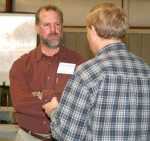
A speaker at the Republican River Riparian Partnership conference in McCook Tuesday encouraged Nebraska, Colorado and Kansas to work together as "one tri-state area," rather than as adversaries, to address the challenges facing the river that provides an invaluable lifeline for each state.
Scott Chartier, a fish expert from Wray, Colo., encouraged those gathered to discuss what they want the Republican to look like in "YR2037 and Beyond," to depend only on research that is not "politically motivated."
Rick Mullaney of Sterling, Colo., coordinator of the Northeast Colorado Resource Conservation and Development, (formerly of the RC&D office in Cambridge), and Rick Hedke of Trenton, coordinator of the Southwest Weed Management Area Project, echoed Chartier's advice.
Mullaney encouraged those at the conference, "to get rid of political borders." Hedke stressed the importance of "cross state-line planning."
Mullaney listed some of the challenges: environment, weeds, fuel shortages, social changes/labor force, economics (global and local) and, "politics -- they're bigger than we want to admit."
But, Mullaney said he often repeats the old adage: "Do what you've always done -- you get what you've always gotten." Do something different, Mullaney said, and the outcome will be different.
Merle Illian of Red Cloud, coordinator of the Trailblazer RC&D, said that the first year of the project to eliminate invasive species on 78 miles of the eastern Republican River to the Kansas line involved 178 of 180 landowners. "Landowners own property up to the center line of the river," Illian said. "All but two agreed to the spraying."
The project involved aerial/helicopter spraying and ground application, and focused on phragmites, reed canary-grass, cattails, willow and some saltcedar.
Illian said he is concerned with the spread of phragmites, which can have runners up to 25 and 30 feet long. Seed-heads project out of even 12-foot water, he said, although the part of the plant submerged is, "mushy. and hopefully won't survive," he said.
Phase II, next year, will seek bids for and the removal of log jams on established islands, Illian said. "Log jams are splitting the river into secondary channels," he said. "The river is not capable of handling the flows it once did because of vegetation and log jams."
Illian said that the islands are not routinely "scoured off," but are layered with more sediment over vegetation. "In time, the vegetation grows through the sediment," he said.
Scott Chartier warned that changes within one aspect of the Republican's environment will affect other aspects. Remove the trees, he said, and he is concerned for the fish. Trees filter herbicides that farmers apply near the river, he said, and keep the river from becoming too warm for fish. "As the river temperature increases, oxygen levels change," he said.
Water quality decreases as water flow decreases, Chartier said.
Chartier said that as much of a money-maker as tourism can be, "if agriculture goes bust, tourism can be a secondary opportunity."
But, he said, "if we lose the river, we're looking at total collapse."
Gary Wells of Lincoln, landscape architect with the USDA National Agroforestry Center on the East Campus of the University of Nebraska-Lincoln, said, "We're living with the consequences of what we've done to the land."
Wells wants to build a 30-year vision of the Republican by building a consensus among irrigators, recreationalists and hunters, working within natural processes and "Mother Nature."
Wells, author of the massive book, "Stream Corridor Restoration: Principles, Processes and Practices," explained in depth how a stream corridor works -- existing ecological conditions, stresses to the stream and trends of the system -- how its ecosystem depends upon surface and subsurface water.
"Do something to one part of the stream, and it affects the ecosystem downstream," he said.
Doug Whisenhunt of Curtis, district conservationist with the Middle Republican Natural Resources District, said he grew up around Benkelman, hunting in the "cottonwood riparian forest/savannah" that was the Republican River then.
"I want the river to look like a cottonwood riparian again," he said, describing healthy, wide-spaced cottonwoods and tall native warm-season grasses.
European man arrived, built dams, stopped natural fires, brought in cattle and changed the existing environment, Whisenhunt said. Non-native species, with no natural enemies, arrived and thrived.
"He didn't change the ecosystem on purpose, not maliciously," Whisenhunt said. "He altered the system for his comfort," demonstrating the indirect effect of man on nature.